
Fond du Lac County Former Owners
Build a small chain table. One row stands for one recorded transfer, not every person who may have held an unrecorded or shared claim. Start at the newest deed. Work backward through each grantor until the trail thins. Drop a question mark into your notes whenever a legal description changes or a date reads unclear.
| Transfer date | Grantor to grantee | Instrument | Reference to retain |
|---|---|---|---|
| Newest first | Current grantor to current grantee | Most recent deed | Recording date, number and description |
| Prior transfer | Earlier grantor to prior grantee | Earlier deed or estate conveyance | Volume/page or document number |
| Older transfer | Prior owner to a prior grantee | Deed, trustee or personal-representative deed | Parties and legal description |
Treat this as a working timeline. It is not a title commitment. Read every deed's parties and legal description from the source image rather than inferring them from a tax card or a map label.
Fond du Lac County Deed Trail
The grantor conveys the interest; the grantee receives it. The chain works backward because each new grantee becomes the next name you search. Confirm the land at every link. One person may sell several parcels, and a near-identical name can sit in the same index without involving your subject property at all.
- Start with the current parcel PIN and legal description in the county card.
- Locate the newest matching deed and record its grantor, grantee and date.
- Search the grantor as grantee to find the prior acquisition.
- Compare each instrument's lot, block, CSM or PLSS description.
- Repeat until the index ends, then switch to the older-book route.
Write down both the deed date and the recording date. Pair the names with a book/page or document number. That citation is the bridge to an older index entry or a paper file at the recorder's counter.
- Chain of title
- The sequence of recorded transfers tied to a parcel.
- Reverse search
- Using a grantor from one deed as a grantee search for the prior transfer.
- Legal description
- The written land description that ties an instrument to its parcel.
- Index entry
- A reference to a document, which may not include the image itself.
Fond du Lac County Deed History
The Register of Deeds offers LandShark research and document purchases back to 1839. That gives Fond du Lac County deed history a long advertised horizon. A separate Index Books path covers records before 1987. The office publishes no exact image-cutover year or full document-type list. So treat 1839 as a research horizon rather than an unbroken run of online images.
When the modern result stream stops, switch paths. Move to the pre-1987 index books. Transcribe the names, volume and page, recording date, instrument type, and legal description. Do this before moving to the next grantor. A copied citation saves repeat searching. It also helps a counter clerk pull the source record.
Open LandShark's registration and index choices to see the current navigation.
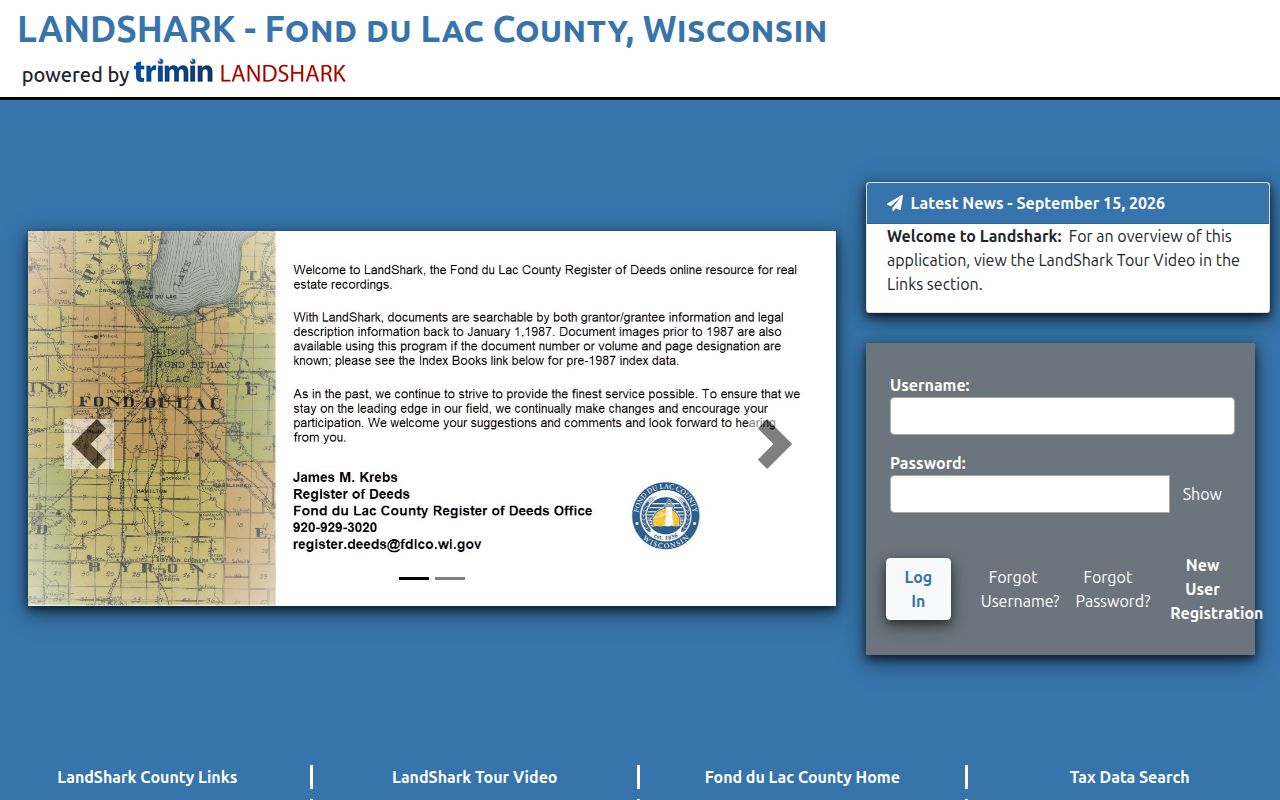
Ask the Register of Deeds directly. A cited book or image may sit online, on a public terminal, or behind another county access route.
Fond du Lac County Deed Index Books
Older ownership records use different name forms. A modern owner may carry a middle initial, punctuation, or a business suffix missing from the earlier deed. Search the exact spelling first. Then try variants supported by the parcel or another instrument.
The index books make the transition visible. Note the volume, page, or document number you followed. Record whether each entry is a grantor or a grantee reference. If it cites a town, range, or section, keep that wording as written. A modern street address should wait until the deeds prove it is the same land.
County public terminals allow document viewing. The office publishes no image-fee or certified-copy schedule, so confirm any charge before ordering.
Fond du Lac County Parcel Changes
A street address is a shaky anchor. Parcels get divided, combined, annexed, renumbered, or described by lot and block. The county GIS guide accepts a document number or deed volume/page as search keys. LandShark's Special Searches handle plat names and numbers. CSM numbers carry a C prefix, such as C3038.
Compare the old deed against the plat or CSM. The county's 1864 historic plat maps and 1874 atlas show earlier land patterns. A 2024 plat book offers a $30 overview. The recorded source image controls. If a current city parcel once sat in a town, check an annexation ordinance or the Register of Deeds document cited on a county map.
Do not presume an old name or boundary change from a ZIP code or current postal city.
Fond du Lac County Probate Transfers
Ownership can change without a sale. When a record owner died, search WCCA for a Fond du Lac County probate case. Try the decedent name or a party name. Request the file from the Clerk of Courts or Register in Probate. Look for an inventory, letters naming a personal representative, a sale order, and an executor or administrator deed.
Probate material explains authority. LandShark shows the recorded land instrument. Match the legal description and PIN before treating a family relationship or obituary as proof of a transfer. A death certificate does not establish ownership. Under Wis. Stat. §69.20, certified vital records and some death details carry access limits.
If no case appears online, ask the county court office about older or retained files. The office publishes no probate request form or local fee schedule.
Former Owner Research Beyond LandShark
Older Fond du Lac County records do not all live online. When the digital trail runs cold, four fallback channels can help. These are the Fond du Lac Public Library, the County Historical Society, the Wisconsin Historical Society and State Archives, and FamilySearch. Each may hold pieces of the county's recorded past. Think atlases, deed books, microfilm, directories, and newspapers. Their catalogs list Fond du Lac film numbers and directory year runs differently. Search each one before you plan a visit.
An obituary or a city directory is a starting clue. It can surface a former owner's name or a likely transfer date. Take that clue back to a deed or a probate file. The property transfer actually lives there. Then ask the Register of Deeds for the volume, page, or document number. That citation is what keeps the search moving.
Fond du Lac County Owner History
Fond du Lac County advertises deed coverage back to 1839. Treat that as a search horizon. It is not a promise that every parcel has a full chain online. A gap can mean a name variant or a pre-1987 index reference. It can also mean a parcel change, or an instrument type the search menu simply does not expose. The county has no courthouse loss event in its record-keeping history. So older property records survive. Keep working the angles when a deed does not surface on the first pass.
Older files need their own citation. Capture each index reference before moving backward. If a book or image is not online, ask the Register of Deeds about public terminal or counter access.
A deed history summarizes recorded transfers. It does not guarantee title, reveal every private agreement, or settle a boundary question. Read the recorded instrument itself, and bring in a title professional whenever the question calls for a full title review.
Fond du Lac County Deed Citations
Some older Fond du Lac County citations point to early volumes. Others are bare land descriptions with no street name at all. Write the citation down exactly as it appears. Context comes from maps. The county's Historic Plat Maps date to 1864, and its Historic Atlas to 1874. PLSS layers add township, range, section, and quarter-section detail. That detail can tie an old farm tract to a later city lot. None of these map sources replaces the recorded deed itself.
For material past the online index, the same fallback channels apply. These include Fond du Lac Public Library, the County Historical Society, the Wisconsin Historical Society or State Archives, and FamilySearch. Their exact Fond du Lac film numbers and city-directory year runs vary. Search each catalog by county and record group. Then ask the Register of Deeds for the volume, page, or index book. That record anchors the next step. Wisconsin CCAP reaches back only to 1987. Older court context may still require courthouse files.